
In his powerful book, The Blood Telegram, Gary J Bass, a professor at Princeton University, has exposed how US President Richard Nixon and his National Security Adviser Henry Kissinger 'allied with the killers,' the Pakistani government in then East Pakistan, as it unleased genocide on a horrific scale. Professor Brass discusses Nixon and Kissinger's 'moral blindness,' why they hated India and then prime minister Indira Gandhi, and their plan to draw China into the conflict in an illuminating interview with Rediff.com's Arthur J Pais.

If Trump doesn't like India, that is his choice. But to use such distasteful language on a public platform is deeply offensive and needs to be called out, points out Amberish K Diwanji.
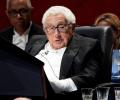
Speaking about the issue in India in March 2012 at a media conclave, Kissinger defended his use of unparliamentary language while referring to Prime Minister Indira Gandhi.

Jazz City could have been enjoyable had it not been so densely over-plotted and unevenly executed, notes Deepa Gahlot.
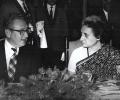
'She was brave. She didn't care a hoot. And India was not the strongest of nations as it is now.'
'She was brave. She didn't care a hoot. And India was not the strongest of nations as it is now.'

The United States' historical strategic alignment with Pakistan, dating back to the Cold War, has consistently aimed to create a political and military parity with India, despite India's significantly larger size and resources. This long-standing relationship continues to influence regional dynamics, particularly in West Asia and the Indo-Pacific.

The delegations from the US and Iran head to Islamabad on Friday, carrying a ceasefire that is already fraying, a Strait that is technically open and practically closed, and a negotiating agenda that would challenge even parties actually negotiating in good faith, which these groups are not. Prem Panicker continues his must read blog on the Iran War.

More than four decades ago, the Nixon administration knowingly broke United States law to help the Pakistani army against Bangladesh and encouraged China to mass troops on Indian border to oppose the strong stand taken by the then Prime Minister Indira Gandhi, according to a new book.
Dr Kissinger died on Wednesday at his home in Connecticut.

Kissinger's approach of balance of power, secret diplomacy and moderating ideology are the need of the hour. That is the greatest tribute to an intellectual who had a major impact on the world in his lifetime, notes Colonel Anil A Athale.

Kangana Ranaut has unveiled the first look of her film Emergency, in which she plays then prime minister Indira Gandhi.

Mrs Gandhi's power ebbed and peaked with the times. Mr Modi's has almost been constant, barring the few months of hard dip after the 240 seats of 2024, points out Shekhar Gupta.

Dr Kissinger, then US president Richard M Nixon's national security adviser, feigned illness on a visit to Pakistan in July 1971 and made a secret trip to Peking, as Beijing was then called, to begin the process of a rapprochement between America and China. It was a debt that Chinese leaders have never forgotten.
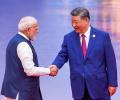
'Xi is an individual led by a harder calculus and would scoff at melting over gestures.' 'That we did not know this was our failure,' asserts Aakar Patel.

While the Indian Government was aware of it, it tried to play it down and instead referred to it as genocide against the Bengali community in Bangladesh so as to avoid an outcry from the leaders of the then Jan Sangh, the predecessor of the today's main opposition Bharatiya Janata Party, says Gary J Bass, author of the book The Blood Telegram: Nixon Kissinger and a Forgotten Genocide, which recently hit the book stores.
C Uday Bhaskar reviews Nixon, Indira and India: Politics and beyond by Kalyani Shankar.

'Geopolitically and diplomatically it's a very difficult situation for India.'
Former U.S. Secretary of State Henry Kissinger, architect of President Richard Nixon's detente with China, faced a new diplomatic challenge on Monday -- helping craft a U.S. bid to host the soccer World Cup.

On December 10, Kissinger began to encourage the Chinese to take action against India: 'If the People's Republic were to consider the situation on the Indian subcontinent a threat to security, and if it took measures to protect its security, the US would oppose efforts of others to interfere with the People's Republic.' On the 50th anniversary of India's greatest military victory, Claude Arpi recalls how the US suggested that China intervene militarily on Pakistan's side.

A day after Dhaka was liberated on December 16, 1971, then US President Richard Nixon was told by his strategic advisor Henry Kissinger that he had 'saved West Pakistan,' according to confidential papers since declassified by the US department of state.

The scaling up of the India-US strategic partnership to the level of non-NATO ally with defence deals, sharing and transfer of defence technology, interoperability, joint collaboration and joint production of defence equipment has exacerbated Moscow's anxiety, notes Rup Narayan Das.

The US government was readying a strategy should India smash military power of West Pakistan.

Any miscalculation and miscommunication are fraught with the risk of a major catastrophe, warns Rup Narayan Das.

With a decelerating economy that weakens India's hands on geopolitical issues, it will be interesting to know which way this trip will go.
On a visit to Afghanistan and in a meeting with Mohammad Daoud, the Head of State and Prime Minister, Kissinger had shared a number of views including those on India, non-alignment and the personality of Gandhi.
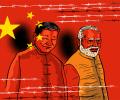
'Some have speculated that it has to do with Doklam and the 2019 elections.' 'That Modi asked Xi not to embarrass him by sending the Chinese army into Bhutan again, this time rolling over our resistance,' says Aakar Patel.

Indian policymakers must realise that in buying small quantities of equipment, it becomes hard to start manufacturing them in India, explains Ajai Shukla.
Former US secretary of state Henry Kissinger had called Indians 'bastards' and Washington had pushed China to attack India IN 1971. Should India ignore these comments and proceed to build ties with Washington, DC?
Contrary to the scenario in 1998 when the Indian nuclear tests invited sanctions from Washington, there was a concerted effort on the part of Richard Nixon administration, led by Secretary of State Henry Kissinger, for a low-key response to India's "peaceful" nuclear explosion, the newly-released documents said.

'The tank battle was fought at ranges of 300-700 metres.' 'It was a rare example of the complete destruction of a squadron by another squadron.'
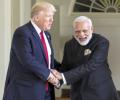
India must be aware that there is no question of the US fighting the Chinese on land. We have to fight our own battles, points out Virendra Kapoor.

India has much paranoia in India about a new 'Terroristan' coming up between Pakistan and a Taliban-ruled Afghanistan. Pakistan has zero ability economically, diplomatically, geostrategically or militarily to create one. If they try, it will be great for India as they will destroy themselves yet again, asserts Shekhar Gupta.
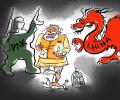
'China need not worry about a truly 'resurgent India'.' 'It's not going to happen.'

'America's withdrawal from Vietnam was an inspiring moment for all of us. We believed that it was a glorious victory of ideology and spirit and as historic as the defeat of the Nazis exactly 30 years ago,' remembers Kumar Ketkar 40 years after the end of the Vietnam War.
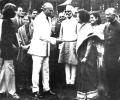
'Indira Gandhi, it appears, did not to consult her Cabinet colleagues, or diplomats, or civil servants when she decided to sign the agreement in Shimla.' 'We ruefully recall Bhutto's perfidy and the Indian prime minister's gullibility,' says Lieutenant General Ashok Joshi (retd).

Jaishankar noted that it would be difficult to say what will happen in the future as there are a lot of "contradictions and frictions" out there today.
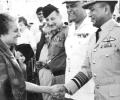
There are times in each nation's life when the gods shower their blessings on it. The right leaders are in place and they make the right decisions. Everything seems to click and good luck favours its people. Such times came to this country 50 years ago, recalls Admiral J G Nadkarni (retd).
 © 2026 Rediff.com - Advertise with us - Disclaimer - Privacy Policy - Sitemap - Feedback - About us - Terms of use - Grievances